If you’re managing an enterprise PI System with multiple plants feeding into a central or regional PI Data Archive, you already know: when something goes wrong, it’s not always obvious where it started.
A PI Vision display may go blank. A KPI might suddenly dip. A report is missing values.
And the central team is left wondering:
“Is the issue with our central PI system? Or is something wrong at the plant?”
Data Issues Start at the Source and Often Go Undetected
In most architectures, local PI Data Archives at the plant level feed data to a central PI Data Archive via PI-to-PI interfaces. It’s a powerful setup but one that obscures root cause tracing when something fails downstream.
- A sensor goes bad at the plant →
- The local tag flatlines →
- The central tag continues to show a stale value →
- PI Vision displays and dashboards show incorrect data →
- No one knows where it broke.
By the time someone notices, the plant team didn’t know they were sending bad data, and the central team doesn’t know where to look.
How Osprey Bridges the Gap
Osprey now supports data lineage across PI-to-PI connections, helping teams trace data from central systems all the way back to the plant-level source.
Here’s what you can do with it:
Map Tag Relationships Across Archives
- Osprey automatically detects when a PI Tag in the central data archive is sourced from a plant archive via a PI-to-PI interface.
- It builds a lineage path from source tag → interface → destination tag.
- You can explore these connections visually or export them as a report.
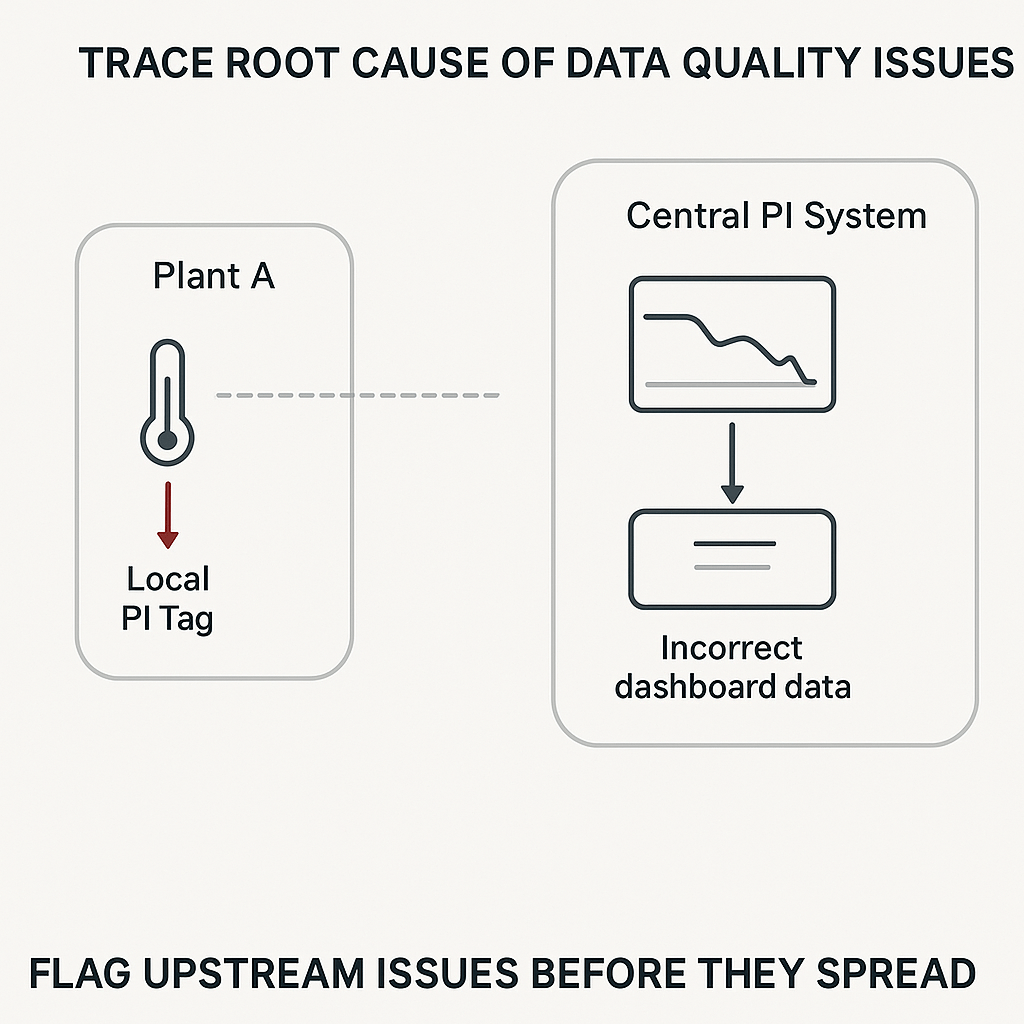
Trace Root Cause of Data Quality Issues
- If a central tag has bad or stale data, Osprey helps you identify whether the problem originated at the source plant.
- You can quickly see if the source tag is missing, stale, or out of bounds even before the central tag shows visible symptoms.
Flag Upstream Issues Before They Spread
- Osprey can flag bad data at the source tag level even if it hasn’t yet been noticed in the central PI system.
- You can alert the right plant team before operational dashboards are affected.
Why This Matters for Enterprise PI Architectures
In multi-plant environments, this changes everything:
- Central teams gain visibility into root-cause issues they couldn’t previously diagnose.
- Plant teams get early warning that their systems are pushing bad data upstream.
- Data owners can take responsibility for their part of the chain.
- Trust in dashboards and reports improves across the board.
Example: One Bad Tag, Many Consequences
Imagine a compressor temperature tag at Plant A flatlines due to a failed sensor. The local PI Tag stops changing but PI-to-PI still replicates the last known value to the regional archive.
- The regional KPI for “Average Compressor Health” looks normal but it’s false.
- A display in corporate PI Vision shows the wrong value.
- A maintenance optimization report is built on corrupted assumptions.
With Osprey, you would see the lineage path, flag the issue at the plant level, and trace it all the way back before the downstream impact cascades.
 Tycho Data