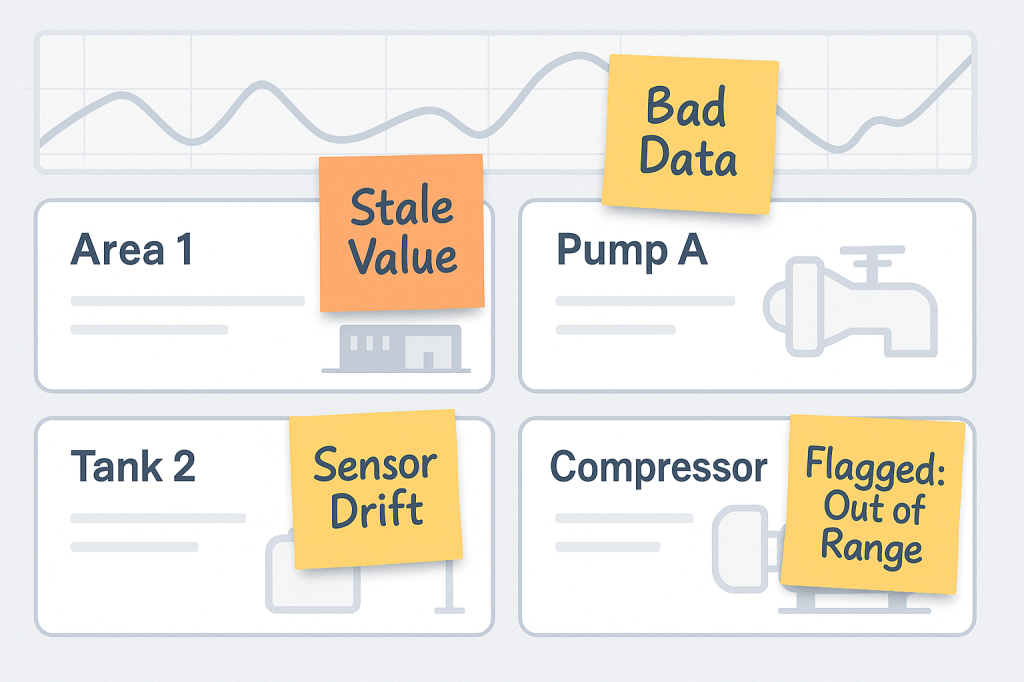
⚙️ Industrial Data Reality: Known Problems, Bigger Unknowns
In asset-heavy industries like oil & gas, chemicals, power, and manufacturing, engineers rely on the AVEVA PI System to monitor critical assets, such as compressors, reactors, turbines, pipelines, 24/7. But even in some of the world’s most sophisticated plants, data quality issues persist.
👉 Most industrial companies face persistent data quality issues in their operational systems – a reality widely acknowledged by engineers, operators, and reliability leaders.
👉 Yet, few have a formal, structured method for consistently capturing, prioritizing, and addressing those issues based on operational or financial impact.
As one PI power user recently told us:
“We know our tags are broken. We just don’t know which ones matter enough to act on, or how to track what we’ve spotted.”
That’s the real risk. Not the data problems you know, but the ones you don’t.
📊 The Reality in Industrial Operations
Industrial leaders, especially PI admins and reliability engineers, do not have time to review and fix all the issues in their PI System:
Industrial teams can’t fix everything. What matters is knowing which tags and data streams are critical to safe, reliable, and profitable operations and having confidence in their accuracy. Without that visibility, companies leave themselves vulnerable to hidden operational risks and financial losses.
In mission-critical environments, bad data isn’t a small inconvenience:
- It can trigger false alarms, bad AF Analyses, or missed process excursions.
- One missed issue on a high-value compressor can cost $250k–$5M in lost production per incident.
Top-performing plants know this:
- Tie data quality issues directly to operational and financial outcomes.
- Track suspected or confirmed issues the moment they’re spotted.
- Use annotations, issue logs, and prioritization frameworks to close the loop.
🛡 The Problem: PI Users Can’t Easily Log or Track Issues
Today in many plants:
- An operator notices a bad reading, but doesn’t log it.
- A process engineer questions a flatline trend, but emails it, and it’s lost.
- A control systems team sees stale tags, but has no way to flag them against business priorities.
Without a lightweight, embedded system to annotate and track these issues, they stay hidden.
And hidden issues quietly cost you money.
🦅 How Osprey Solves This
Osprey’s asset annotation feature lets PI System users:
- Quickly flag issues when they spot them in PI Vision displays, AF structures, or data tables.
- Capture qualitative observations such as “bad data”, “stale data”, “out of expected range”.
- Tie annotations to business-critical assets or tags using your existing AF hierarchy.
- Track these issues over time, with the ability to prioritize by business impact.
This turns informal observations into structured, actionable data.
🔍 What the Best Plants Do (And How You Can Too)
Top performers, leaders in reliability, asset management, and operational data do this differently. They:
- Track every known or suspected data issue in a lightweight, centralized system, ideally connected to their PI System or AF.
- Prioritize based on risk, financial impact, and asset criticality, not just engineering gut feel.
- Feed these issues back into maintenance, engineering, and reliability processes.
With Osprey:
- You gain that lightweight issue capture layer directly tied to your PI System.
- You enable a culture of data accountability.
- You help your team focus on the critical data issues that drive majority of your business risk.
📝 Closing
Bad data is inevitable. Unknown bad data is unacceptable.
Annotations turn passing observations into shared operational knowledge and give industrial teams a way to act on what matters before it hurts production, safety, or profitability.
With Osprey, PI power users can finally capture, track, and prioritize data quality issues tied to what the business actually cares about.
Ready to See It in Action?
If your team depends on PI System data to keep your plant running safely and efficiently. Osprey is built for you.
 Tycho Data